
Handrail & Guardrail Systems: The Complete Construction Guide
Whether you're a contractor specifying handrails for a commercial development, a facilities manager maintaining industrial safety barriers, or a fabricator building bespoke balustrades — choosing the right components and understanding how they work together is essential for a safe, compliant, and cost-effective result.
At
This guide covers our full product range, how each system works, compliance standards, and a step-by-step approach to specifying and installing your handrail or guardrail system.
Why Handrail & Guardrail Systems Matter
Handrails and guardrails are a legal requirement across a wide range of environments — from construction sites and industrial facilities to public buildings and rooftops. Getting them right protects your employees, keeps you compliant with HSE regulations, and reduces your exposure to costly enforcement action or litigation.
Key legislation and standards governing handrail and guardrail installation include:
| Standard / Regulation | Application |
|---|---|
| Work at Height Regulations 2005 | All work where falls could cause injury |
| Building Regulations Part K | Stairs, ramps, and guarding in buildings |
| Building Regulations Part M / Equality Act 2010 | Accessibility requirements for public spaces |
| BS EN ISO 14122 | Industrial walkways and access platforms |
| BS 4592 | Open steel flooring and handrails |
| HSE HSG76 | Warehousing and storage safety |
Our Product Range
Ball Standards
Ball standards (also known as ball stanchions) are fully fabricated upright post systems consisting of a base plate for bolting to a structure and two balls, each with a grub screw for passing tube through and locking in place.
Available styles include:
- Side mounted — for fixing to the face of a structure
- Top mounted — for fixing to the top surface of a structure
- Angled — for staircases and ramps where the post must follow the rake of the slope
- Raw steel — for fabricators who need to cut, weld, and galvanise to bespoke requirements
Ball standards are commonly specified in the water treatment industry, with companies including Thames Water, Anglian Water, and Veolia regularly using our range to maintain safety and functionality across their UK sites.
When used with our galvanised tube range, ball standards create a safe, long-lasting guardrail system that meets stringent industry specifications.
Key Clamp Fittings
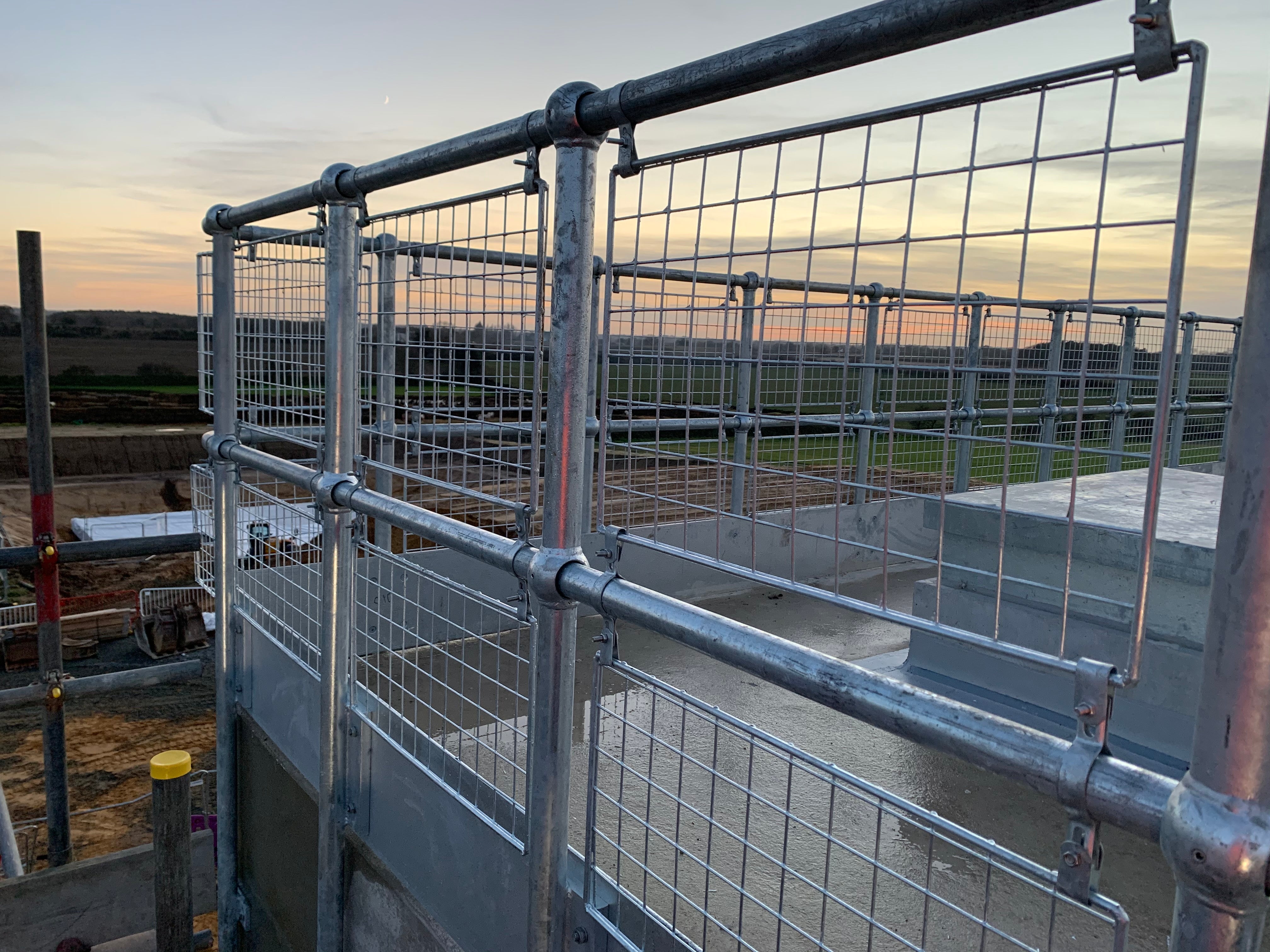
Key clamp fittings are one of the most versatile and widely used components in handrail and guardrail construction. These malleable iron fittings connect lengths of steel tube without welding, making them ideal for on-site assembly and adjustable configurations.
Available fitting types include elbows, tees, crosses, end caps, swivel sockets, base plates, and rail brackets. Key clamp systems can be used to construct:
- Staircase handrails and balustrades
- Roof edge guardrails and workplace safety barriers
- Pedestrian barriers and crowd control systems
- Industrial safety rails and mezzanine guardrails
- Machine guarding and vehicle segregation barriers
The system works by tightening a grub screw with a standard hex/Allen key to lock the fitting securely onto the tube — allowing quick installation, easy adjustment, and straightforward disassembly when required.
Key clamp fittings are available in galvanised steel (standard for most industrial and construction applications) and GRP (for environments with electrical hazards, chemical exposure, or marine conditions).
DDA Handrail Systems
The Disability Discrimination Act (DDA) — now incorporated into the Equality Act 2010 — sets out requirements for accessible design in public buildings and spaces. DDA-compliant handrails ensure that ramps, staircases, and walkways are safe and accessible for all users, including those with mobility impairments.
Key requirements for DDA-compliant handrails:
- Continuous graspable rail — easy to grip along its full length with no obstructions; typically powder coated for a warm-to-the-touch surface
- Correct diameter — typically 40mm–50mm outer diameter for a comfortable grip
- Horizontal extensions — rails must extend horizontally at the top and bottom of ramps and stairs to assist users in steadying themselves
- Contrasting colour or finish — to aid visibility for partially sighted users
Our DDA handrail components work seamlessly with key clamp fittings and galvanised or powder coated tube, making it straightforward to build fully compliant access handrails for public buildings, transport infrastructure, and commercial developments.
Galvanised Steel Tube
Galvanised steel tube forms the structural backbone of any handrail or guardrail system. Its excellent corrosion resistance makes it suitable for both indoor and outdoor use — including exposed environments such as car parks, bridges, rooftops, and coastal locations.
Available diameters:
| Diameter | Nominal Bore | Typical Application |
|---|---|---|
| 33.7mm OD | 1" NB | Light-duty handrails and infill rails |
| 42.4mm OD | 1¼" NB | Standard handrails and DDA-compliant systems |
| 48.3mm OD | 1½" NB | Most widely used — key clamp guardrails and structural handrails |
| 60.3mm OD | 2" NB | Heavy-duty guardrails, main posts, bump rails, and low-level barriers |
Galvanised tube can be cut to length on site and connects directly into our key clamp fittings and ball standard range, making it easy to work with even in complex or irregular layouts.
Industrial Safety Applications
Handrail and guardrail systems are a critical component of industrial site safety. Common applications include:
Pedestrian & Vehicle Segregation In warehouses and industrial facilities with frequent vehicle movements, physical barriers are essential to separate pedestrians from forklifts and delivery vehicles. Key clamp guardrails and
Mezzanine & Platform Guardrails Mezzanine floors, loading platforms, and elevated walkways all require compliant edge protection. Key clamp systems can be configured to any layout and are quick to install without specialist equipment.
Machine Guarding Barriers around machinery protect workers from moving parts and restricted zones. Key clamp systems offer the flexibility to create bespoke guarding configurations that can be reconfigured as layouts change.
Roof Edge Protection For rooftop access and maintenance, our
Non-Slip Flooring Proper flooring is an often-overlooked safety measure. Our
Step-by-Step: Building a Handrail or Guardrail System
1. Plan your layout Determine the run of the handrail or guardrail, including any changes in direction, height requirements, and fixing points. Check the relevant compliance standards for your application.
2. Choose your system and components Select the appropriate system — ball standards, key clamp, or DDA — based on your project specifications. Our
3. Select your tube diameter Choose the appropriate galvanised tube size based on your chosen system and any DDA or building regulation requirements. Post centres typically vary between 1.1m and 1.5m depending on tube diameter — larger diameter tube is stronger and allows wider post spacing.
4. Order and receive delivery All components are available online with fast UK delivery and competitive trade pricing. Our team can advise on quantities and specifications if needed.
5. Assemble on site Measure and cut galvanised tube to the required lengths for rails and posts. If using ball standards, posts are pre-fabricated and won't need cutting. Assemble fittings using a standard hex/Allen key — no welding or specialist tools required.
Why Choose Lockinex?
- Comprehensive range — ball standards, key clamp, DDA handrail, galvanised tube, GRP options all in one place
- Trade pricing — competitive bulk pricing for contractors and fabricators
- Fast UK delivery — stock held for rapid despatch
- Expert advice — our team can help you specify the right products for your project
- Compliance confidence — all products meet relevant British Standards and HSE requirements
Browse our full range online or contact our team for expert advice and bulk pricing:
Lockinex UK Ltd Store
Need Help Specifying Your System?
Contact our team at