
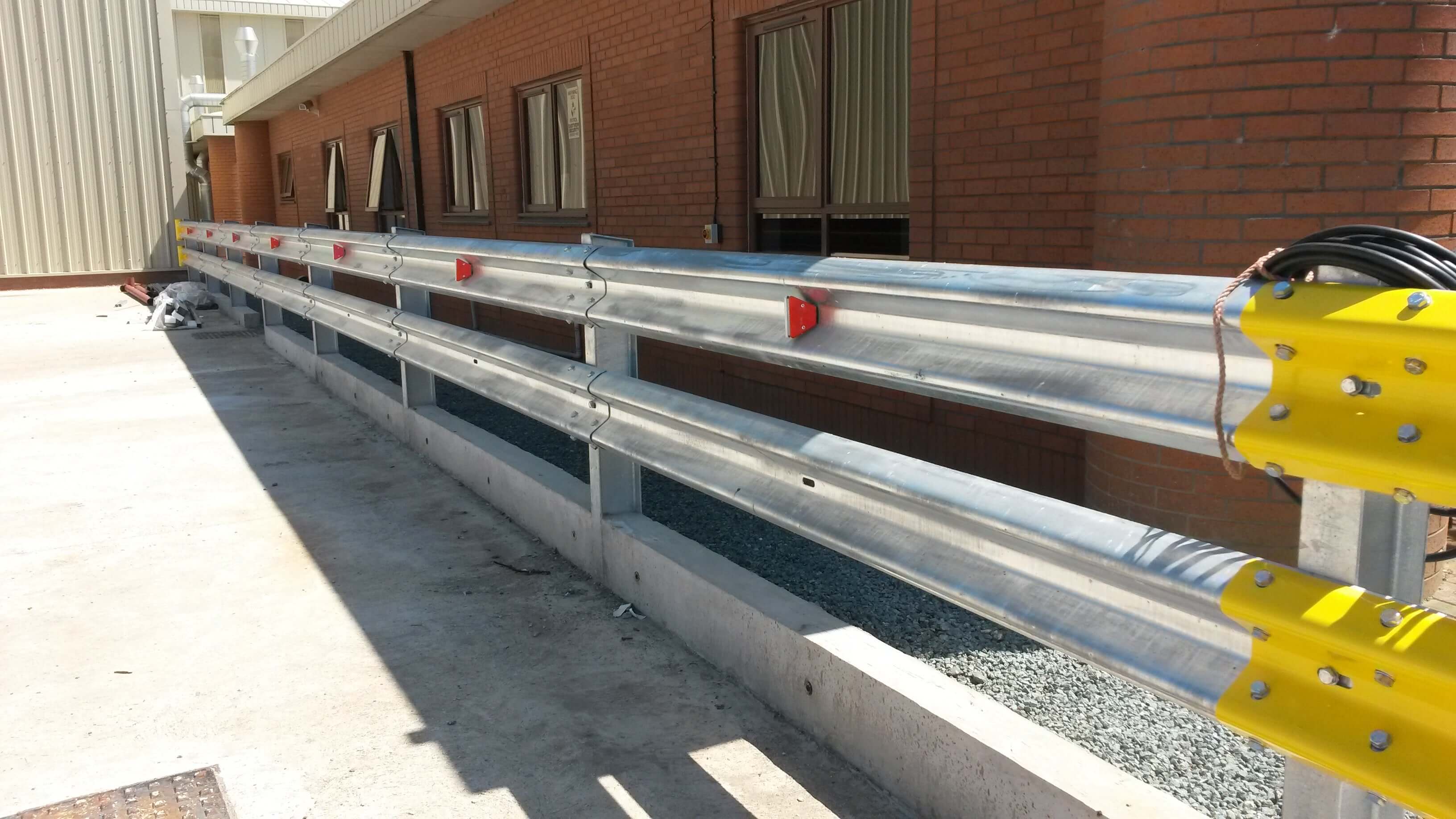
Lockinex M.R.Armco Crash Barriers: The Ultimate Guide
Crash barriers are an essential safety measure found on roads, highways, car parks, warehouses, industrial sites, race tracks, and private roads. Made from strong, corrugated steel, they are designed to prevent vehicles from leaving the roadway or entering hazardous areas.
The primary role of these barriers is to absorb the impact of a collision, reduce the severity of accidents, and guide the vehicle back onto the road — or prevent damage to structures and assets. They protect vehicles, personnel, and infrastructure, significantly contributing to overall safety in both on-road and off-road environments.
In this guide, we explore
What Are Armco Crash Barriers?
Armco barriers, named after the American Rolling Mill Company that pioneered their design, are heavy-duty corrugated steel safety barriers originally developed for roadside crash protection. Today, they are the gold standard for industrial, warehouse, and off-highway applications where high-impact resistance is required.
These modular systems consist of corrugated steel beams mounted on sturdy posts, creating a flexible yet strong protective barrier that absorbs and redirects impact energy. Unlike rigid concrete barriers, Armco systems are designed to deform slightly upon impact — dissipating force and reducing damage to both the barrier and the impacting vehicle or object.
What Makes Armco Barriers So Strong & Reliable?
The performance of Armco barriers comes from two key factors: material and design.
- Material: Constructed from high-strength corrugated steel, typically hot-dip galvanised for corrosion resistance. This gives a minimum outdoor service life of 25 years, and up to 85 years in less harsh environments.
- Design: The corrugated (wave) profile allows the beam to flex upon impact, dissipating collision energy progressively rather than transferring it rigidly. This controlled deformation is what makes Armco so effective at reducing injury and damage.
Impact Resistance: Understanding the Values
This is one of the most important — and most misunderstood — aspects of Armco barrier selection. Choosing the wrong system for your impact risk can result in barrier failure, injury, and non-compliance.
How Impact Resistance Is Measured
For on-road applications, impact resistance is governed by EN 1317, the European standard for road restraint systems. This standard defines:
- Containment Level (N, H, L classes) — the severity of vehicle impact the barrier can contain
- Working Width — how far the barrier deflects during impact
- Severity Index — the level of occupant risk during a collision
Common EN 1317 containment levels relevant to Armco:
| Containment Level | Typical Application | Vehicle Type |
|---|---|---|
| L1 / L2 | Low-speed roads, car parks | Passenger cars |
| N1 / N2 | Standard highways | Cars and light vans |
| H1 | High-speed roads, motorways | HGVs up to 13 tonnes |
| H2 / H3 | Motorways, high-risk zones | HGVs up to 38 tonnes |
For off-road and industrial applications, BS 6180 provides guidance on barriers in and around buildings, specifying required loadings for different scenarios.
kN Impact Ratings for Industrial & Warehouse Use
For warehouse, car park, and industrial environments, impact resistance is typically expressed in kilonewtons (kN) — the force the barrier system can absorb before failure:
| System Type | Impact Rating | Typical Application |
|---|---|---|
| Single-rail | Up to 5 kN | Pedestrian zones, light segregation |
| Double-rail | 15–25 kN | Standard warehouse forklift traffic |
| Triple-rail | 50 kN+ | Loading bays, HGV areas, high-traffic routes |
Vehicle Impact Reference Guide
To put these values in context:
- A pedestrian exerts negligible force — single-rail is sufficient for pedestrian segregation
- A pallet truck travelling at low speed generates approximately 3–8 kN
- A counterbalance forklift (2.5 tonne) at typical warehouse speeds generates 15–30 kN
- A reach truck or VNA truck can generate 20–40 kN depending on speed and load
- An HGV or articulated lorry can generate 100 kN+ in a significant impact
This is why double-rail is the minimum recommended for any area with active forklift movement, and triple-rail is essential at loading bays and main thoroughfares.
Single, Double & Triple Rail — Which Do You Need?
Single-Rail Barriers A single corrugated beam mounted at approximately 500–600mm height. Suitable for pedestrian protection and light segregation. Not recommended for areas with vehicle traffic.
Double-Rail Barriers Two parallel beams — the lower rail (300–500mm) prevents wheel contact, the upper rail (800–1000mm) protects vehicle bodies and loads. The most common configuration for warehouse and car park environments with regular forklift and pallet truck movement.
Triple-Rail (Heavy-Duty) Systems Three beams providing maximum impact resistance. Required for loading bays, main vehicle thoroughfares, and any area where HGVs, reach stackers, or heavy plant operate. Essential where EN 1317 H-class containment is needed.
Armco vs. Standard Guardrails: What's the Difference?
Both serve to protect vehicles and assets, but Armco barriers are significantly more durable and engineered for higher-impact situations than standard guardrails. Standard guardrails are often made from lighter materials such as aluminium and are more suitable for low to moderate-impact zones. Armco's corrugated steel construction and proven impact absorption make it the trusted choice in high-risk environments.
Key Components of an Armco System
Barrier Beams The corrugated steel rails forming the primary impact surface. Standard lengths are 1.0m, 1.8m, and 3.5m. The corrugation provides structural strength while allowing controlled deformation during impact.
Support Posts Vertical columns anchoring the system to the floor. Typically spaced 1.5m–3m apart depending on expected impact forces. Heavy-duty applications require closer spacing.
End Caps & Terminal Posts Prevent sharp edges and provide proper termination points. Terminal posts are reinforced to handle additional stress at barrier endpoints. Hi-visibility polymer ends and corners are recommended for maximum visibility.
Installation Process
- Site survey — identify optimal barrier placement, assess floor condition (minimum 150mm concrete depth required), and check for underground services
- Post fixing — secure steel posts by bolt-down onto concrete or by concreting in, depending on site requirements and impact risk
- Beam attachment — attach corrugated
steel beams usingheavy-duty lap joint bolts to create a continuous protective barrier - Height setting — lower rail at 300–500mm (forklift wheel height), upper rail at 800–1000mm (vehicle body/load height)
- Testing — conduct pull tests on a sample of fixings to verify anchor integrity; document with photographs for compliance records
Post spacing guidance:
- Standard warehouse: 2.5m–3m
- Heavy-duty/high-impact areas: 1.5m–2m
Compliance & Standards
Depending on your installation environment, your Armco barriers should comply with:
| Standard | Application |
|---|---|
| EN 1317 | On-road and highway use — defines containment levels, working width, and severity index |
| BS 6180 | Off-road barriers in and around buildings — specifies required loadings for warehouses, car parks, docks |
| HSE HSG76 | Warehousing and Storage Safety — requires physical barriers to segregate pedestrian and vehicle zones |
| HSE HSG136 | Workplace transport safety guidance |
| Workplace (H&S) Regulations 1992 | General workplace safety compliance |
Many insurance providers also offer reduced premiums for facilities with comprehensive, compliant barrier installations.
Maintenance & Inspection Schedule
Armco barriers are built to last — with proper maintenance, a minimum service life of 20–30 years, and up to 85 years in less harsh environments. The hot-dip galvanised construction provides strong corrosion resistance with minimal upkeep.
Weekly: Visual walk-through — check for visible damage, loose fixings, or deformation. Assess any impact damage immediately.
Quarterly: Check all fixings for tightness, inspect clamp connections for cracks, verify barrier alignment. Document and schedule repairs.
Post-impact: Inspect the entire barrier run after any significant collision — not just the impact point. Hidden damage to adjacent fixings can compromise system integrity.
Replacement criteria: Barriers showing permanent deformation beyond 100mm, cracked welds, or damaged fixings should be repaired or replaced promptly. The modular key clamp design makes component replacement straightforward.
Cost & Return on Investment
While the initial investment in quality Armco barriers may seem substantial, the ROI is compelling:
- Accident prevention — a single serious injury can cost tens of thousands in compensation, lost productivity, and HSE investigation time
- Asset protection — preventing damage to racking, columns, or machinery pays for barrier systems many times over
- Insurance benefits — reduced premiums and excess fees for compliant facilities
- Operational continuity — avoiding downtime from structural damage or accident investigations
- Compliance confidence — reducing risk of enforcement action or prohibition notices
Most warehouse operators find comprehensive barrier systems pay for themselves within 2–3 years through avoided costs alone.
Ready to Specify Your Armco System?
Explore our
Need help specifying the right system for your site?